Through the use of concrete details, setting can be a very influential aspect of creative writing. Even if a setting could be perceived as “usual” or “boring”, it can be made interesting and important if described concretely. Setting allows the reader to jump into the scene alongside the characters and experience their surroundings with them. The author can use distance and viewpoint to change the perspective the reader has on the scene that is unfolding. Setting can also be used to create mood or atmosphere and can be symbolic of what is taking place in the story. For instance, a warm sunny day might make the reader feel warm at heart and an icy, stormy day might indicate that a scary or dangerous plot-line is in the works.
Characterization
When I was a child, I thought she was a witch. I was not a mean child, I was simply prone to believing what I saw with my own two eyes, and what I saw told me that my great aunt was a witch. She lived in a tumble down shack she built mostly by herself in my family’s pecan grove overlooking the lake filled by the muddy Mississippi. The shack was covered in kudzu and I have to imagine that the stray cats guarding it were only outnumbered by the termites living inside the rotting cypress walls. When we would play in the front yard of Granny’s house we would sometimes get too close to her shack and she would lean her hunched, wrinkled frame out the window, cigarette hanging out of her mouth, and cry out to us, “If one of y’all sends that football through my stained glass, I’ll put all your dirty faces on my dolls.” All of us kids knew that her “dolls” were VooDoo dolls, procured from the big city of New Orleans. This vague, empty threat, when repeated enough times, was plenty for my eight year old brain to pair it with her army of stray cats and decide that she was of the broomstick-riding variety. To say that my cousins and I avoided her is an understatement. As an adult, I realize that she is no witch at all. In fact, she is a poet whose lovely flowing lines about life reek of someone who’s seen a lot of it. And she has. Most of life has treated her poorly. Divorced from an abusive husband, runaway children, drug-addicted grandchildren, you know, the works. This broken life has led her to shield herself from the world behind her rotting, cypress walls smoking Marlboro’s, drinking Corona’s, and writing lyrical poetry. She doesn’t have many years left on this cruel planet and all she wants out of those years is peace, and for her unruly great nieces and nephews to not throw a football through her windows.
Voice, As I Understand It
The voice of an author is centered around how they express themselves throughout their body of work via word choice, syntax, imagery, idiom, rhythm, and range. Simply, an author’s voice is how they would sound if they were speaking to you instead of writing. The author’s voice can also be represented tangentially through the persona of a narrator, which may be a version of the author themselves or a separate entity entirely, or through the voice of their characters. The voices of the author, the narrator, and the characters can lead the reader to conclude certain things about the work itself. Does this character use lofty language? Maybe they are well educated or wealthy. Does the narrator use clipped, rather harsh word choices to describe a specific character? It could be that they are angry with that character. An author can also reveal things to the reader by employing a voice with irony or distance. Is the author actively involved in the proceedings of the scene or are they merely observers, quietly judging the action at hand? These are all things that can be revealed to us by the many voices utilized in writing.
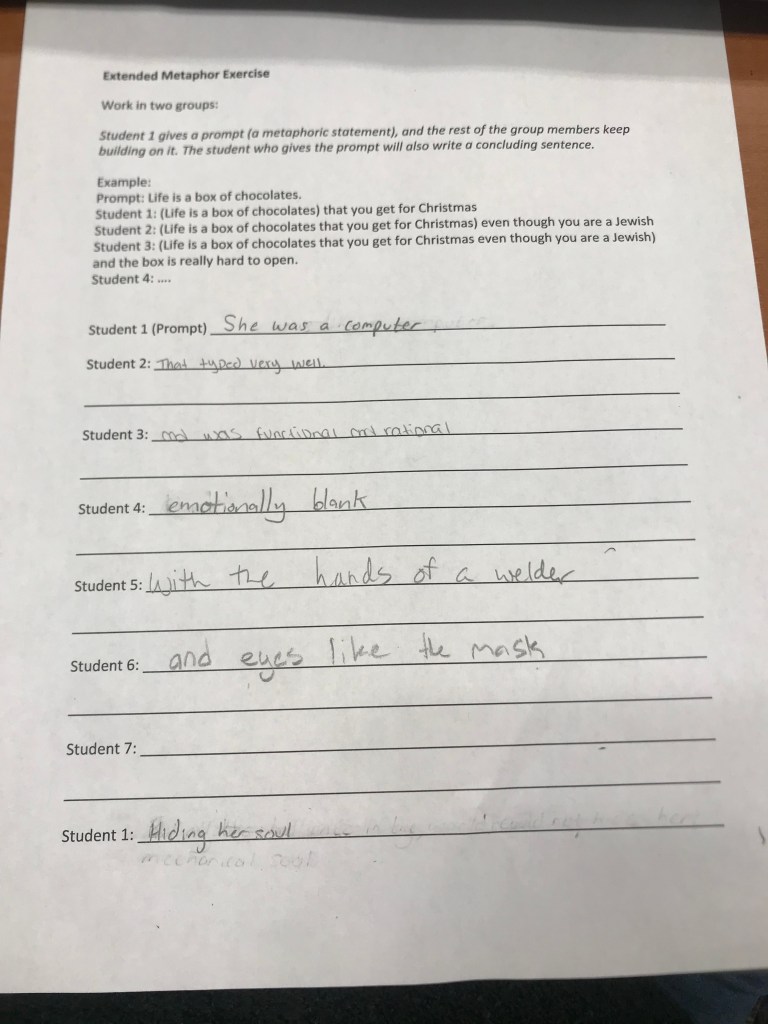
In Class Extended Metaphor Exercise
In class writing: 1/22/20
She was his dream and he was her dream, but like all dreams, they cannot last forever. Everyone must eventually wake up and meet the blinding sunlight of morning, you can try to shade your eyes, but that won’t stop the sting. Chase’s stained t-shirts and jeans sit above his muddy boots and beside her business professional suits in their temporarily shared apartment. Blue collar, White collar, her hands unbuttoning his collar just last night. Chase is a pipeliner with a job lined up in the badlands. Desiree is a actress whose first big break broke last week when she got a call from her agent about a guest role on CSI: New York. The sweet aroma wafting from flowers on her nightstand and the soft snoring of the man beside her in bed tell a story that would lead one to believe their life together was a Hallmark movie and she’d gotten the man, the kiss, and the happy ending. But what she and Chase are both all too aware of is that below the flowers, in the top drawer of her nightstand is a plane ticket and after they drag themselves out of bed to the coffee that is drip, drip, dripping into the ceramic pot, Chase will be left behind to scrub the loose grounds from the cups. All because they woke up.
Imaginative Writing
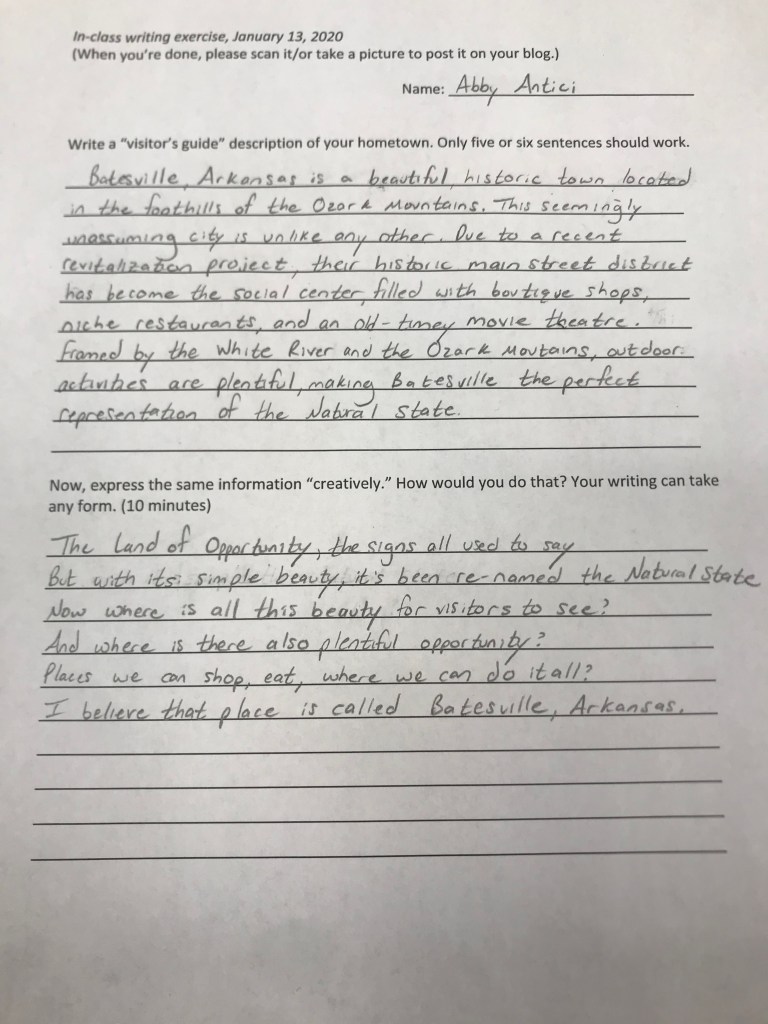
The salt spray whips through my hair as I grow closer, closer, closer
The land becomes one with the horizon as I move further, further, further
The sea calls me like an old friend calling the landline in your childhood home because they thought of you and that is the first number they remembered
So click, click, click, ring, ring, ring… we’re connected, the sea and me
It remembers my number, it remembers how to call me, where to find me
And it knows that I will answer every time
Concrete, Significant Details
“Excuse me, that is my seat,” said the pink woman with the peacock feathers sticking out of her oddly shaped hat. She was now a rather large woman and her ballooning figure was highlighted by her ill fitting church suit that reeked of money so fake it must’ve come from a monopoly game. The suit was a rather off-putting color somewhere between aqua and baby poop green that sort of matched the peacock feathers adorning her head, but also sort of didn’t. “I apologize, I must have missed your name tag on it,” I replied. But I did not move an inch in either direction. Neither did the pink woman. “Excuse me,” she said indignantly, “that is my seat.” “So I’ve heard,” I said in reply, staying as still as a rock in the desert that hasn’t moved since Pangaea. You see, the church that I sat and she stood in was a big building with small pews, so there was more than enough room for everyone to have a seat. The church also had a big steeple with a small cross, a big stage with a small altar, and, I was coming to find out, big people with small minds. “I’m sorry,” the pink woman began again, “you must be new here, everyone else knows that this is my seat.” “Oh, they do? It must be the best seat in the house if your love affair with it is so widely known. I think I will see for myself if it lives up to it’s promise,” I replied, with a smirk. I could see her eyes begin to crease around the edges, as her smile became more like a grimace. “I’m sorry, you don’t understand,” she said, as her peacock feather slid to the side of her hat, balanced as precariously on the side of her head as her sanity was balanced inside it. Just then, the piano started playing a hymn about loving your Christian neighbors to signal everyone to find their seats, or someone else’s before the beginning of service. I thought this signaled my victory in the matter of the particularly contested seat, but then the strangest thing occurred. Unable to stoop so low as to take one of the abundant, inferior seats in the church, the pink woman sat down in the floor next to the pew on which I sat. She remained there for the duration of the service. When the bell tolled the end of the hour signaling the end of our worship, I finally pushed myself up from the seat to make my exit. Before I could escape, however, she grabbed my arm and said, “Son, you happen to be one of the most stubborn men I have ever met and you should be ashamed of yourself for allowing a woman to sit on the floor while you took her seat.” “Ma’am,” I replied, “Sitting in the floor was your own choice.” She scoffed at my response and said, “What is your name?”, sounding less like she actually cared and more like she intended to later report me for theft of her square of the church pew and needed it for the police report. “Jesus,” I replied, and I watched the pink woman turn white with shock and make a mad dash for the restroom. A moment later, as I sat in my old truck, I heard the rhythmic tinkling of my cell phone in the console. “Hello, this is Gus, how may I help you?” I spoke into the receiver.
My Shitty First Draft
The chicken factory reeks of shit… or maybe chicken guts?
Conflicted by the smell of bread being backed for you, me, … us
It’s all one block off from the river where the kids all laugh and play
Nose-blind to their hometown’s smell in Batesville, AR USA
I Write
My favorite genre of creative writing is poetry. I grew up listening to my mother read Shel Silverstein poems to my brother and I as though they were bedtime stories. I wrote a considerable amount of poetry in my AP Literature class in high school. One of these poems was even published. However, I merely received a grade on many of these poems and the verbal or written feedback was very limited. I hope to gain feedback in this class that will better my poetry skills. In my free time, I am a songwriter. In my eyes, songs are merely poems put to music. The two go hand in hand. If one can become a good poet, they could also become an excellent songwriter. I hope to one day become an excellent songwriter, and I hope this class can help me in reaching that goal.
Assignment 1
 Abby's Creative Writing Workshop