When reading a work of fiction, there is an accompanying film projected onto a metaphorical screen inside your mind. You can “see” the characters enjoying a Sunday picnic in the park, you can “hear” the boy yell to his mother from the top of the staircase, you might even be able to “smell” the cherry pie being baked in the back of the cafe. The beauty of books vs. film, however is that the movie in your mind might be different from the movie in someone else’s. Fictional books allow for this sort of interpretation. However, they must not be vague or there could be no movie at all. This is the role of concrete, significant details. The author must describe things in such a way that the reader can “see”, “hear”, and “smell” everything that the characters are experiencing. The author must also manipulate the plot in such a way to keep the projector rolling at a steady pace. If the plot is too quick, it could appear comical. If the plot is too slow, you might as well give your brain a remote to turn the movie off. Ultimately, writers of fiction and writers of movies can learn a lot from one another and should view each other’s work as though it could teach them something about their own.
Modeled after Fiesta, 1980
We like cruises. We- meaning my brother, my mother, my father, and I – go on them every chance we get. We took my grandmother once, she didn’t like it. Said she appreciated getting to see more of the world, but didn’t like the boat. She said it moved too much. I guess she meant the waves. When we first arrive at the port to “embark” on the ship, dad changes. My mother refers to it as “vacation dad”. It’s not that he’s a bad father ordinarily, he is a very good one. The best. But, “vacation dad” doesn’t worry about money. Doesn’t gripe about the fact that coke in Jamaica costs $4.50 because nobody wants to drink the water. “Vacation dad” affects mom too. She doesn’t worry about time. No be here then, do this then, say that then. Time is a construct that doesn’t follow us on the ship. This is a good thing, as time so regularly follows us in our daily lives. When we first board the ship, my mother and father, with their newly changed attitudes and perspectives, retreat to their cabin. My brother and I are left with two choices. Explore the ship or unpack. We always explore the ship. It is never very different from the last ship or the next ship, but we ooh and aah nonetheless. Last time, when my grandmother was with us, I left my brother with her. I went to the pool deck and laid out on a chair in exactly what I had on when I boarded the boat. Remember – we don’t unpack first. I laid in that chair for two hours and read. I don’t know what book. I read many books. I do remember getting up. My skin crinkling under the sunburn, bright red and itchy for weeks. A reminder of what happens when one is selfish and pawns off their younger brother the first chance they get.
The Ones Who Walk Away from Omelas diagram
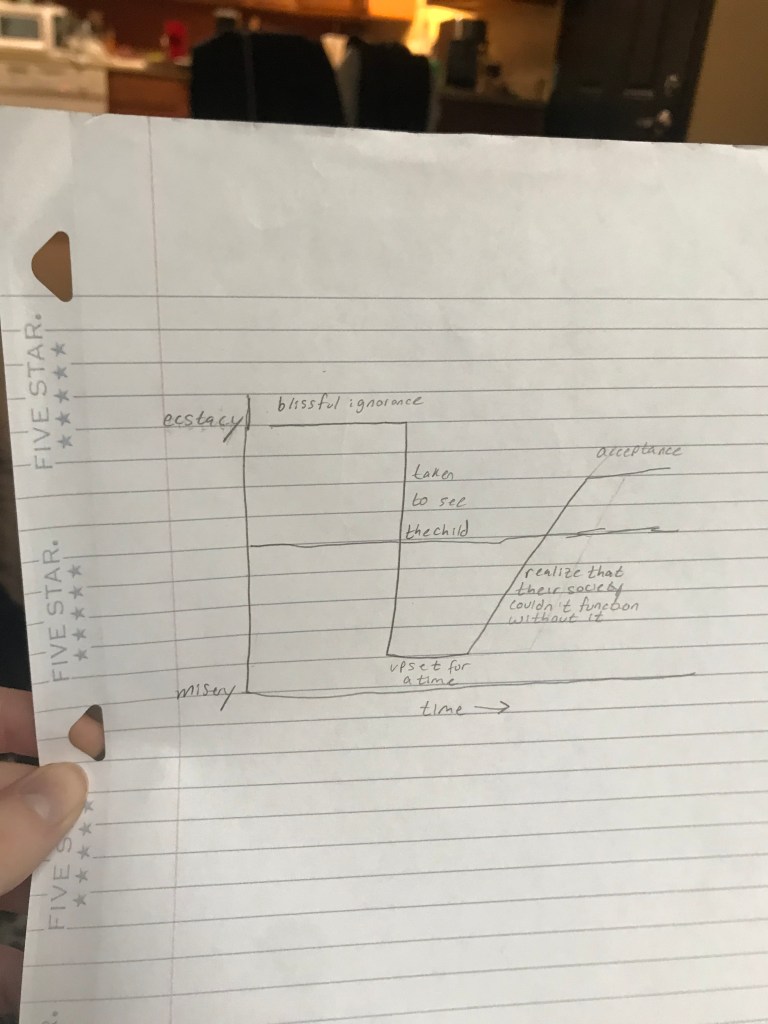
Plot, As I Understand It
The plot of the story encompasses the action that occurs during the “present” or the “right now” of that story. However, the plot does not have to be chronological. The plot could be a minute, a day, or a year in the life of a character but could be used to reveal pieces of the backstory that influence the “right now”.
Fact and Truth in CNF
Creative Non-Fiction has a complicated relationship with truth. While non-fiction must inherently be true, putting any event on paper alters it in some way. Additionally, in an attempt to enhance the creativity of the piece, we must think deeply about the event to extract details. While these details may seem accurate to us, they may be incorrectly remembered depending on how long ago the event took place. Ultimately, the truth of the piece is relevant to the author themselves.
Reflection Exercise 2/17/20
My grandmother gave me a painting of a girl. The girl is beautiful, painted in every color of the rainbow with her hair dripping down her back onto the shoulders of her flowy summer dress. She is holding an umbrella and dancing in the puddles of the rainbow rain. My grandmother said that girl reminded her of me. While I do not understand the intricacies of her statement, the girl looked nothing like me, it is perhaps the most beautiful thing I have ever been told. You see, the painting was produced by a blind painter. By all known laws of sight and art, it should not have existed at all. And yet it did, and here it is, dancing through the rain across my bedroom wall. I will cherish it always.
Piece modeled after “Sleepless in Any City”
Vienna, June 2019. Roughly 1:30 am. I need to get to sleep. In 3 and a half hours they will come knock on the doors and pull all fifty of us out of bed to make our flight back to the United States. But, I don’t want to go home. Back to the normal, everyday slog of Batesville, Arkansas. I want to stay here in the exciting rush of a European city where everyday holds new possibility for adventure. The people are freer here, happier. Maybe that is what is keeping me awake, but maybe not. Maybe it is the drip drip drip of the shower head that won’t shut off. It’s not a matter of “oh you should just get up out of bed and turn it a little more to the right, silly.” We’ve tried that already. All four of us, confined in this small room with bad mattresses in the budget motel near the airport, have tried to turn off that shower at various points tonight. The other three have all nodded off, escaping the noise in the realm of dreams, but I am here awake. Just me and the drip drip drip. I wonder if anyone in the other rooms can hear it. Are their showers similarly leaky? I send a message in the group chat to ask. No one responds, it is 1:30 am after all. I must be the only one awake, except for the shower. Just me and the drip drip drip.
It Really Happened
It was unseasonably cold for May, even for New York City. My family and I were enjoying the brief respite from the already repressive heat of an Arkansas summer. As we exited the hotel, we were loaded down with rain jackets, ponchos, and umbrellas. We had booked a double-decker bus tour to Little Italy and China Town and despite the rain, we were still planning on sitting on the top deck so as not to miss any of the sites. We had made our way through the red velvet upholstered lobby with the gold accents and arrived at the big glass and gold doors. The doorman kindly held them open and I barreled out into the rain and the crowds that were constant this close to time square. Without thinking, I popped open my over-sized umbrella. To my immense embarrassment the umbrella made contact with a passerby. Lifting the umbrella up over my head and shouting a rushed apology, I made eye contact with the passerby I had hit. He was tall with dark skin and warm brown eyes, and I recognized him. From where, I could not remember. A few seconds passed, long enough for him to melt into the crowd and my family to join me outside and asked what had happened. I looked at my mom and said, “Oh my God. I just hit that actor from Bones with my umbrella. You know, the anthropology intern who falls in love with the boss!” “Our first celebrity sighting,” my mom replied, “and you whacked him with your umbrella. Way to go, Ab.”
In Class Exercise: 2-5-20
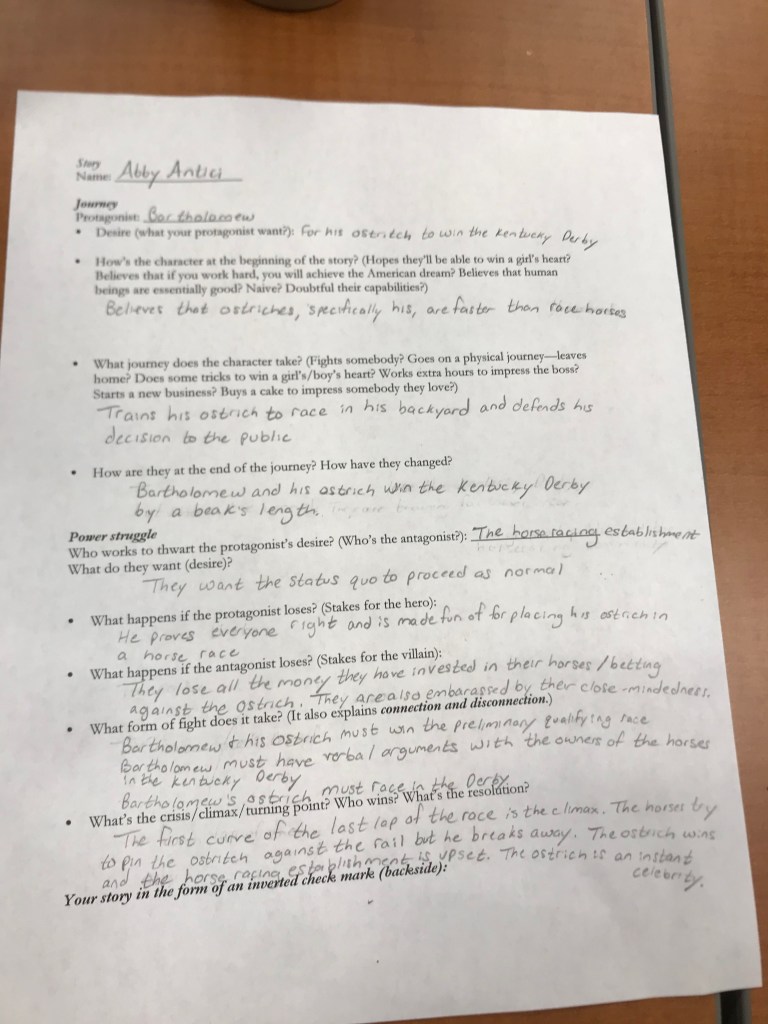
In Class Exercise: Setting
Landscape:
-In the Louisiana bayou
-murky oxbow lake off the Mississippi River
-General Grant hid his ships there during the Civil War
-cypress trees/knees with Spanish moss hanging from them
-dock that’s been added on to as the family has grown and the lake has receded
-mosquitoes that will carry you away
Ambiance:
-spooky
-rural
-antiquated
Characters:
-a lonely old woman whose family lives far away
-she is shriveled with age, but still retains the dignity of someone with money
-her face is riddled with laugh lines and sun spots
-she clutches a coffee cup filled with community coffee and a dash of Kentucky bourbon
Paragraph:
In the Louisiana bayou, on the shore of one of the state’s oldest Oxbow lakes, sits the happiest house in Caddo parish. The house is happy because it is waiting, but the woman on the sun porch is unhappy because she doesn’t believe she can wait any longer. You see, the house is more patient than her, it always has been. She would like to go take a dip in the lake, maybe fish a bit off the dock, but the weather today had other plans. So she’ll drink her morning coffee with bourbon here on the porch and watch the rain drip drip drip into the lake. It’s hard to imagine that over a hundred years ago the lake was filled with warships. Today, it has only one small one motor boat captained by the man who only fishes in the rain. He claims he catches more fish then, but she is certain the only thing he’ll catch today is a cold. It is unseasonably cold for July. She hopes that it will warm up before her family arrives next week. Then she will be happy. Then she won’t have to wait.
 Abby's Creative Writing Workshop